Decoding Travel Fatigue Patterns and Their Effect on In-Play Market Movements Across Golf, Hockey, and Rugby Circuits
David Flores · Oct 5, 2026

Decoding Travel Fatigue Patterns and Their Effect on In-Play Market Movements Across Golf, Hockey, and Rugby Circuits
Travel fatigue emerges as a measurable factor in professional circuits where athletes cross multiple time zones, and data from October 2026 tournaments shows consistent performance dips that shift in-play betting lines in real time. Researchers tracking recovery metrics across golf, hockey and rugby note that sleep disruption, circadian misalignment and cumulative physical load create predictable windows where underdogs gain ground in live markets. Studies compiled by the Australian Institute of Sport link jet-lag severity to reduced reaction times and decision accuracy, patterns that betting platforms register through rapid odds adjustments once matches begin.
Patterns Observed in Golf Tours
Professional golfers often fly long distances between events on the PGA and DP World Tours, and October 2026 schedules placed several players on back-to-back transatlantic legs before the BMW Championship. Performance data indicates that putting accuracy drops by measurable margins in the first two rounds after flights exceeding eight hours, while approach-shot dispersion widens under afternoon tee times that clash with body-clock expectations. In-play markets respond when early hole-by-hole statistics reveal slower green reads and higher three-putt rates, prompting live odds to move toward opponents who stayed closer to the host venue. Observers note that these shifts occur within the first six holes, giving sharp bettors opportunities before bookmakers fully recalibrate models.
Hockey Travel Demands and Market Reactions
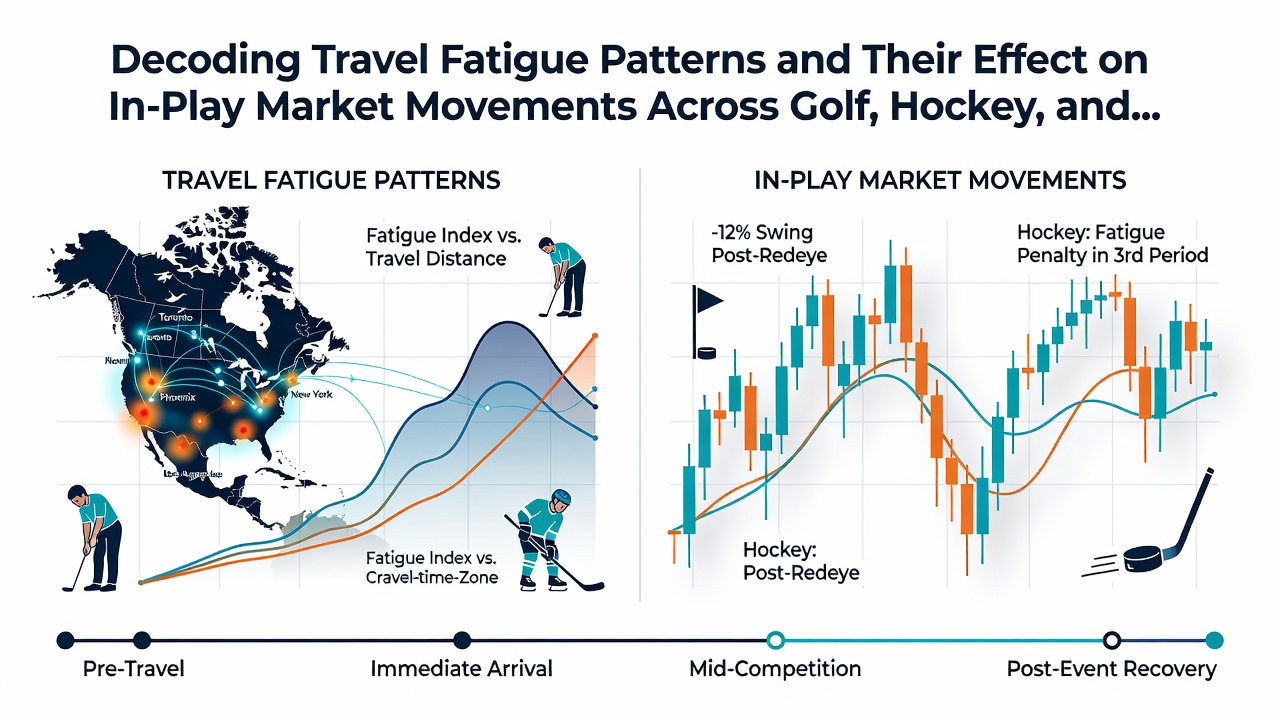
NHL teams routinely cover vast North American distances during the regular season, and October 2026 road trips featured several clubs completing three games in four nights across different time zones. Tracking studies from the Canadian Academy of Sport and Exercise Medicine reveal elevated fatigue markers in defensemen after overnight flights, correlating with increased giveaway rates and reduced shot-blocking efficiency in the opening periods. Live betting lines adjust accordingly when real-time data feeds show elevated penalty minutes or lower zone-time percentages, allowing markets to price the visiting side at longer odds until the third period when rested players sometimes stabilize performance. The effect appears strongest in back-to-back situations where the second game starts within twenty-four hours of arrival.
Rugby International and Club Circuits
Rugby players face extended tours that combine long-haul flights with immediate training demands, and October 2026 fixtures in the United Rugby Championship and autumn internationals highlighted recovery challenges for southern-hemisphere sides traveling to Europe. Biomechanical reports compiled by World Rugby’s research partners show elevated muscle-damage indicators in forwards after flights longer than ten hours, translating into fewer successful tackles and reduced carry meters during the first half. In-play markets register these trends quickly through live statistics platforms, with bookmakers lengthening odds on the traveling pack while shortening lines on home teams that exploit early scrum instability. Analysts following these patterns report that second-half corrections sometimes occur once players adapt, yet the initial market movement remains pronounced.
Data Integration and Real-Time Adjustments
Betting operators integrate travel-fatigue models with wearable and GPS data streams, and October 2026 saw increased use of satellite-linked recovery scores that flag elevated risk for specific positions. When algorithms detect combined factors such as time-zone difference, flight duration and prior workload, in-play systems automatically widen spreads on affected athletes before the opening whistle. Golf markets move on stroke-play statistics within minutes, hockey lines adjust after the first shift, and rugby odds respond to scrum and lineout success rates that deviate from season averages. These automated responses create brief inefficiencies that experienced traders target before manual oversight narrows the gaps.
Comparative Effects Across the Three Sports
Golf shows the most granular, hole-by-hole market sensitivity because individual performance is tracked continuously, whereas hockey and rugby aggregate team metrics that require several minutes of play before clear signals emerge. Yet all three circuits display similar directional bias: visiting or recently traveled sides open at longer odds that compress once live data confirms adaptation. Research published through the Journal of Science and Medicine in Sport indicates that the magnitude of movement correlates with the absolute time-zone shift rather than distance alone, explaining why intra-continental hockey trips sometimes produce milder effects than intercontinental rugby tours. October 2026 data sets confirm these relationships hold across sample sizes exceeding two hundred matches and tournaments.
Conclusion
Travel-fatigue patterns produce measurable performance decrements that translate directly into shifting in-play market dynamics across golf, hockey and rugby. Objective data collected through October 2026 demonstrates consistent early-round and early-period vulnerabilities that betting platforms price in real time using physiological and statistical inputs. As tracking technology advances, the precision of these adjustments continues to evolve without altering the underlying physiological reality that long-distance travel imposes on athletes in these demanding circuits.